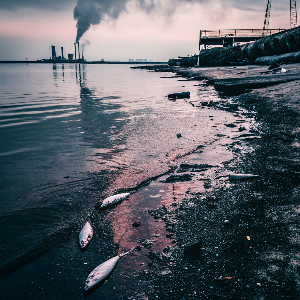
Based on the materials of the roundtable of the Institute for Global Politics
“Environmental Security and the Consequences of War: Challenges, Threats and Ways to Overcome Them”
“The Black Sea Is One of the Most Polluted Seas”
One of the components of Ukraine’s overall security is its environmental safety. The Union of Officers of Ukraine raised this issue for the first time on January 10, 1992, when active anti-Ukrainian demonstrations began in Sevastopol on Moscow’s orders. This was one of the factors that showed that the Black Sea Fleet was becoming a springboard for the future Russian-Ukrainian war. Since then, the Officers’ Union has been appealing to the relevant authorities, including the President and Ministers, about this issue. But the answer was always the same: “This issue is not timely”.
On November 24, 2011, at the Central House of Officers, the Union of Officers of Ukraine organized a roundtable discussion on the issue of ensuring environmental safety of military activities, after which they made another appeal to the state leadership. And today, during the Russian-Ukrainian war, we are convinced that we were not mistaken in our warnings.
We have no actual data on what is happening today in Sevastopol, in Crimea, as a result of the Russian occupation. But according to the data from 2011, the Russian Federation had 200 to 300 thousand tons of ammunition in its arsenal on our territory. And at least half of them were obsolete, which should have been immediately disposed of at that time. Within the city of Sevastopol, there are warehouses of the 17th Arsenal and the 1584th Naval Technical Missile Base, where today, as in the past, more than 3,000 conventional railway wagons of artillery and small arms ammunition are stored. This is an undeniable example of the threat to the environment of the Ukrainian state.
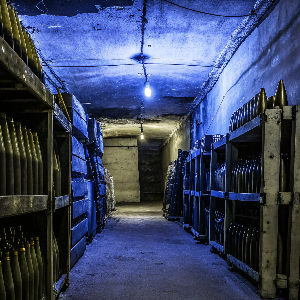 We should also keep in mind such facts as the ammunition flooded by the Black Sea Fleet ships on the Sevastopol traverse. For example, more than twenty years ago, in the summer and autumn of 2004, on the outer roadstead of Sevastopol, large amphibious assault ships “Orsk” and “Tsezar Kunikov” sank aircraft munitions that had reached the end of their service life. By the way, the personnel of the Black Sea Fleet knew that it was strictly forbidden to anchor on a particular course from Sevastopol. The reason for the prohibition was that back in Soviet times, ammunition was transported there on civilian barges, which were also dumped along the route. This is also the Black Sea Fleet’s “contribution” to the environmental safety of Crimea.
For example, according to some reports, tens of thousands of tons of explosives have been accumulated in underground storages near Sevastopol alone. In particular, there are at least 80 underground casemates in Holland Bay, which also contain a considerable amount of ammunition. The underground arsenal in Sukharna Balka is “stuffed” with them, as is the torpedo arsenal in Troitska Balka, which, by the way, is located under a residential neighborhood. There is evidence that some obsolete ammunition on the territory of the depots, such as near Feodosia, is simply covered with earth. Residential neighborhoods have also been built there, in a seismically unstable area.
Also, the ecology of the Crimean Peninsula has been negatively affected since the postwar years of the last century by the former arsenal near Inkerman, which was blown up during the retreat of Soviet troops in 1941. Huge blocks of stone are piled up at that site, but no one is interested in what is left under them. There is also information about the sending to the bottom of obsolete ammunition and chemical warfare agents in the bays of Sevastopol during the division of the Black Sea Fleet. For example, according to scientists from the Sevastopol National University of Nuclear Energy and Industry, there are 1,150 ships at the bottom of the Black Sea, most of which are on the continental shelf of the coastal zone. Experts say that the estimated total weight of ammunition on all the sunken ships exceeds 20,000 tons. Most of the sunken ships have diesel fuel residues in their tanks and airbags amounting to approximately 100 thousand tons. There is a real threat of this fuel leaking due to metal corrosion, which will definitely affect the environment.
In general, chemical waste dumps have long been formed mainly as a result of the Black Sea Fleet’s activities on the coastal shelf west of Sevastopol, where one of these dumps is located – the Kherson dump. Its negative impact on the environment can be evidenced by the so-called method of securing the flooded chemical munitions found there, which are covered with concrete caps on the seabed. Over the past decades, has anyone asked what is happening under those concrete caps? And how long can that concrete shelter exist?
Another environmental sea issue is the problem of garbage disposal on board ships. In Soviet times, all garbage was thrown overboard. But in the civilized world, where people care about the environment, every steamer and warship has special containers.
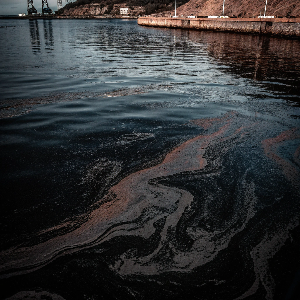 By the way, please, be reminded, that the Black Sea is one of the most polluted. It is closed, and garbage has been dumped into it for tens or hundreds of years, which then floated to the surface. And this is nothing but a dismissive attitude to nature, which needs to be changed, i.e. we need to take care of our environment. In the Mediterranean Sea, compliance with environmental regulations is closely monitored by using an airplane that constantly flies over the Mediterranean Sea to monitor compliance with environmental requirements. As for the Black Sea, there is no such monitoring, although our activists have made proposals and filed lawsuits with the relevant authorities, proposing to make the Russian side comply with the environmental legislation of Ukraine, which threatens to cause emergencies.
What’s next? How do we take care of our environment so that it remains as it should be and meets the best standards? By the way, not everyone can understand the problems of military sailors better than the sailors themselves.
The fleet and the problems of the fleet are also people’s problems. And when someone reassures us that we are somehow already adapting to all these toxic substances, it is worth reminding that we have younger generations of our Ukrainian citizens who need to be taken care of today. After all, environmental damage may significantly affect their existence in the future.
Yevhen LUPAKOV,
Honorary Chairman of the Union of Officers of Ukraine,
Member of Parliament of Ukraine of the 2nd convocation,
Captain 1st rank, retired